Do sensors need cell service or Wi-Fi?
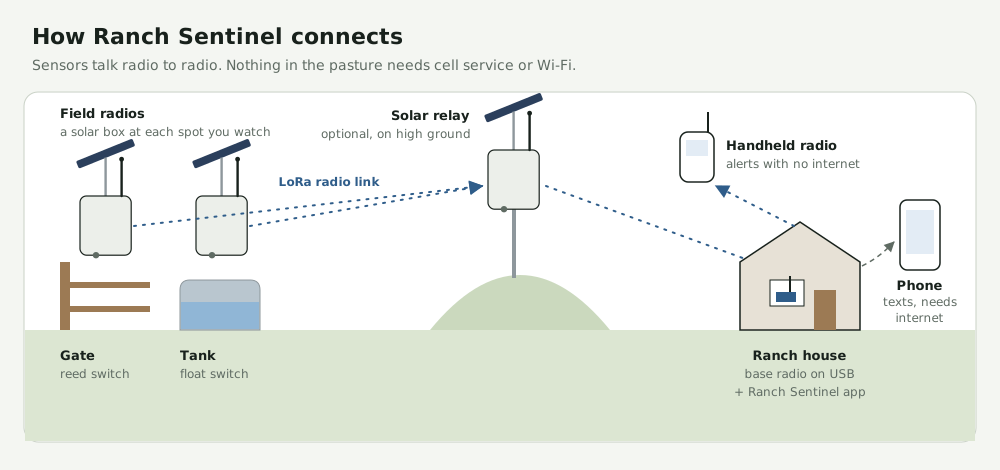
Field sensors use Meshtastic-compatible radios to reach the base. Add a solar relay where a direct link is unreliable.
Do I need internet at all?
Local monitoring and mesh alerts are designed to run at the base. SMS needs internet at the base. Loading online satellite imagery and checking from town also require connectivity, and remote access is planned.
How do text and radio alerts differ?
SMS travels through a text service to your phone. Mesh alerts travel over your ranch radio network to a compatible handheld or phone paired with one.
Do I have to solder?
It depends on the board, enclosure and sensor. Look for pre-soldered headers and compatible connectors. Confirm the wiring for your exact parts before ordering.
How long does setup take?
Allow time to assemble and bench-test the first node, then test it at the actual mounting spot. We will publish measured setup times with the field builds.
What does it cost?
A solar gate or tank sensor is $239 to $259 as a parts kit, or $299 to $309 with the radio already set up. Shipping is included. Every ranch needs one Base Station ($109, or $149 set up). The Ranch Starter Kit (base, gate and tank alarm, all set up) is $699. The software is free for up to 3 devices; the Ranch plan adds text alerts and unlimited devices, with no per-sensor fees.
How long does shipping take?
2 to 3 weeks. We get the parts from the makers, check every one, set up your radios if you ordered pre-configured, and ship it all to you in one box.
What's the difference between the options?
Parts kit: every part in one box, and you put it together with our step-by-step guide. Pre-configured: same box, but the radios are already set up and tested; you just wire the sensor and mount it. Fully assembled: ready to mount and turn on. Join the waitlist and we'll tell you when it's available.
What if the power goes out?
Field nodes and solar relays can run on their own batteries. The base computer and radio need power to process and deliver alerts. A suitable battery backup can help keep them running.
How far apart can devices be?
Coverage varies with terrain, vegetation, antenna placement and mounting height. Test at the actual locations before relying on an alert.